Surge protection and grounding work covers two related but distinct scopes. Surge protection limits how much voltage from a surge event makes it to the home’s wiring and connected equipment. Grounding establishes the path for fault current to return safely to the source, which is the foundation for every other protection in the system. Both matter. Without good grounding, surge protection has no reference. Without surge protection, grounded equipment still gets damaged when surges propagate through the wiring.
The most common scopes: whole-house surge protector installation at the panel, individual surge protection for sensitive equipment (home theater, server rack, networked equipment), ground rod installation or replacement when the existing ground is missing or undersized, supplementary ground rod installation per NEC 250.53(A)(2), bonding correction at the water pipe and other electrodes, and ground impedance testing during diagnostic visits.
NEC 250 governs the grounding system. NEC 285 governs surge protection devices. Both have specific installation rules that affect long-term performance.
How does a whole-house surge protector work?
A whole-house surge protector mounts at the main electrical panel and ties into the bus and ground. When a surge event occurs (lightning strike on a nearby utility line, switching surge from utility equipment, large motor turning off), the protector clamps the voltage by routing the surge to ground before it reaches downstream wiring and equipment.
Type ratings matter. Type 1 SPDs install on the line side of the service disconnect (between the meter and the main breaker). Type 2 SPDs install on the load side (in the panel after the main). Type 3 SPDs install at the point of use (point-of-use surge strips). Most residential whole-house installs are Type 2 at the main panel.
The clamping voltage and the surge current rating determine the protector’s effective performance. A 40,000-amp protector with a 600V clamp limits the surge to 600V at downstream equipment. A 100,000-amp protector with a 400V clamp does better. We pick the device based on the surge environment and the equipment being protected.
Layered surge protection for sensitive equipment
Whole-house and point-of-use protection are layered, not redundant. The whole-house unit handles large surges. The point-of-use units (good-quality surge strips, UPS units, dedicated SPDs at server racks) handle smaller surges and add a second layer of protection for sensitive electronics.
Most homes benefit from the layered approach. The whole-house unit costs less than replacing damaged equipment in a single surge event. Point-of-use protection costs little and protects against the smaller, more frequent events that whole-house alone would let through.
When does grounding need correction?
Common conditions that trigger grounding correction: an older home with no ground rod or a single rod where current code requires two (NEC 250.53(A)(2) requires supplementary electrode unless a single rod tests below 25 ohms ground resistance), a missing bond between the panel and the water service (NEC 250.104(A)), a damaged or corroded ground conductor at the panel, supplementary electrodes (concrete-encased electrode, supplementary rod) that haven’t been added per current code, and metallic gas piping that hasn’t been bonded per NEC 250.104(B).
The diagnostic visit measures ground impedance with a clamp-on ground tester or a fall-of-potential test. Readings above 25 ohms typically require supplementary electrodes. Readings under 25 ohms are acceptable for the existing electrode but supplementary may still be recommended.
Ground rod installation
Ground rods are typically 8-foot copper-clad steel rods driven vertically into the soil. The rod connects to the grounding electrode conductor (typically #6 or #4 copper for residential service sizes per NEC 250.66) which connects to the panel’s ground bus.
The connection at the rod uses an acorn clamp or a listed ground rod clamp rated for direct burial. The connection at the panel uses a properly torqued lug. Improper connections at either end can dramatically increase ground resistance.
Soil conditions affect rod performance. Sandy soil has higher resistance than loamy soil. Dry climates have higher resistance than wet climates. We measure after install to confirm the rod meets the code or the system needs supplementary electrodes.
Bonding requirements
Bonding ties metallic systems together so they share a common ground reference. NEC 250.104 requires bonding of metallic water piping (when used as an electrode or when over 10 feet of metal pipe is in contact with earth), metallic gas piping (when likely to become energized), and structural metal (when likely to become energized).
Common bonding failures: missing bond between the panel and the cold water pipe at the water meter, missing bond on the gas line where it enters the home, missing structural steel bond in homes with steel framing or rebar in foundation. Each one is a code requirement and a real safety improvement.
What surge protection cannot do
Surge protectors don’t protect against direct lightning strikes on the structure. A direct strike puts more energy into the system than any consumer-grade SPD can clamp. Lightning protection systems (NFPA 780) are a separate scope that involves air terminals, down conductors, and earthing systems.
Surge protectors don’t prevent damage from sustained over-voltage (a failed neutral or a stuck open transformer). Sustained events damage equipment over minutes to hours, not the milliseconds that SPDs are designed to handle. Voltage monitoring and main-disconnect controls handle sustained events.
Surge protectors degrade over time. Each surge event consumes some of the protector’s clamping capacity. A whole-house unit typically lasts 5 to 10 years depending on the local surge environment. Most units have an LED status indicator showing whether the protection is still active.
The grounding electrode system: what it actually does
Every electrical system needs a path to earth. NEC 250 governs the grounding electrode system, the physical connection from the home’s electrical system to the ground itself. The grounding electrode system has several jobs:
- Provide a fault-current path back to the source so breakers and fuses can trip during a fault
- Stabilize voltage during normal operation
- Reduce voltage from lightning strikes, line surges, and other external events
- Prevent dangerous voltage from accumulating on metal parts of equipment
The grounding electrode system is not the same thing as equipment grounding (the green or bare conductor inside cables). The grounding electrode system connects the home to earth; equipment grounding ties metal equipment back to the panel’s ground bus.
What a complete grounding electrode system includes
NEC 250.50 lists the grounding electrodes the home must use. Most homes use a combination of:
- Ground rods. Driven 8 feet into the earth. NEC 250.53 requires two rods spaced 6 feet apart unless a single rod can demonstrate 25 ohms or less to earth (rare in most soil). Two rods in series is the standard residential install.
- Concrete-encased electrode (Ufer ground). A 20-foot length of conductor or rebar embedded in the foundation. Required in new construction where the foundation provides this. Excellent grounding electrode.
- Cold water pipe bonding. The first 5 feet of metallic cold-water pipe entering the home. NEC 250.52 requires this connection where present. Modern PEX water service does not provide this electrode; copper-to-PEX transitions sometimes require additional electrodes.
- Metal underground gas pipe bonding. NEC 250.104 requires bonding of metallic gas piping to the grounding electrode system. Plastic gas service does not require this.
Bonding requirements
Bonding ties metal systems together so they share the same electrical potential. NEC 250.104 covers the major bonding requirements:
- Metal water piping system bonded to the grounding electrode system
- Metal gas piping bonded
- Other metal piping likely to become energized (HVAC, refrigerant, etc.) bonded as required
- Structural metal in the building bonded where it is likely to become energized
Bonding sizes follow NEC 250.66, sized to the service entrance conductors. The bonding conductor connects the grounding electrode system to each metal system at a single point, typically at or near the panel.
Whole-house surge protection
A whole-house surge protective device (SPD) installs at the panel and protects the entire home from voltage transients. NEC 230.67 (in current editions) requires SPDs on services for new construction and major service work in many jurisdictions.
SPD types:
- Type 1 SPDs. Installed on the line side of the main breaker (between the meter and the main). Protect against transients entering from the utility line including direct lightning strikes to the line.
- Type 2 SPDs. Installed on the load side of the main breaker. Protect against transients that pass the main and against transients generated inside the home by motor loads.
- Type 3 SPDs. Plug-in or hardwired protection at the equipment level (the surge strip behind the TV, the SPD at the equipment rack). Last line of defense.
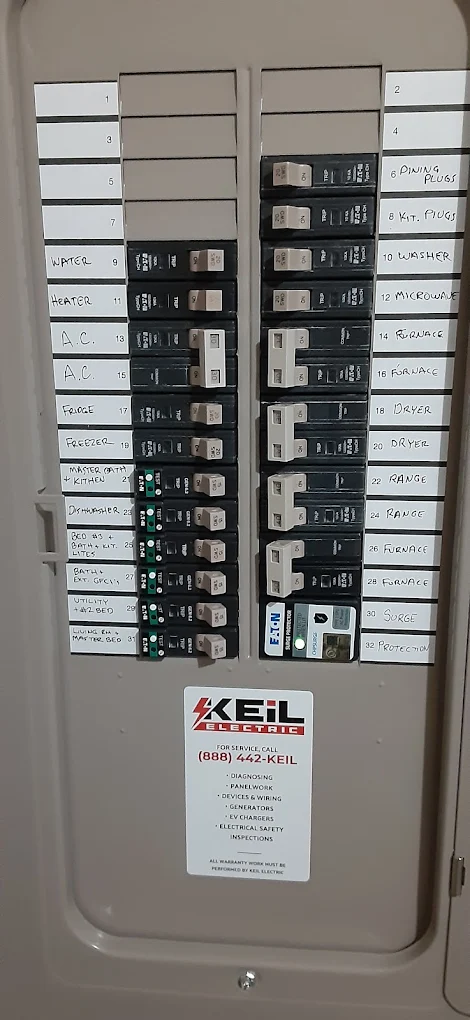
Type 2 SPDs at the panel are the most common residential install. They install in a breaker space and connect to the panel’s neutral and ground bus. The protection is shared across every circuit in the home.
Layered surge protection
Single-point surge protection at the panel is not enough for sensitive equipment. Layered protection covers multiple stages:
- Type 2 SPD at the panel for the bulk surge energy
- Type 3 SPD at the equipment for residual surge that passes the panel
- Dedicated SPDs at high-value or surge-sensitive equipment (home theater, computers, HVAC controls, network equipment)
Each stage absorbs a portion of a surge event. The layered approach gives sensitive electronics the best chance of surviving a major event. NFPA 780 covers lightning protection systems (air terminals, down conductors, structural earthing), a distinct scope from surge protection that some homes pursue when at high risk for lightning strikes.
After a lightning event or major surge
If lightning has struck the home or struck nearby with visible effects on home electrical:
- Inspect the panel for visible damage, discoloration on bus bar, melted breakers, blown SPD indicators
- Test major appliances, HVAC systems, water heater, refrigerator, well pump if applicable
- Inspect outlets and switches for visible damage or burnt smell
- Check the grounding electrode system, rods can shift, connections can break, bonding can be compromised
- Replace the SPD if it has absorbed the event (most modern SPDs have an indicator showing whether they are still functional)
Insurance often covers lightning-event repairs. Document everything before any repair work, photos of damaged equipment, the appliance brands and ages, the SPD status indicator, and the timing of the event.
How we approach surge and grounding scopes
Every Keil Electric service entrance and panel scope includes verification of the grounding electrode system per NEC 250 and bonding per NEC 250.104. We add Type 2 SPDs at the panel as part of any major service-entrance scope and recommend layered protection for homes with sensitive equipment. The work is permitted, inspected, and backed by our written warranty.