The electrical panel is the most important piece of equipment in the home. Every circuit, every load, every outlet runs through it. A panel that’s correctly sized, properly installed, and in good condition makes every other electrical decision easier. A panel that’s undersized, damaged, or part of a known recall is the constraint that drives most major electrical work.
Three questions matter when scoping panel work. Does the existing panel have known safety issues? Is the service rating sufficient for the home’s current and planned loads? Are the breakers themselves working correctly? The answers determine whether the project is repair, replacement, full upgrade, or a combination.
The most common panel work falls into a few buckets: 100A to 200A service upgrades on older homes, replacement of recall panels (Federal Pacific, Zinsco, Challenger), individual breaker replacement after a fault, AFCI breaker installation per NEC 210.12 in renovations, and panel work tied to a major load addition (EV charger, hot tub, addition).
When does a panel need replacing vs repairing?
Upgrade is typical when the panel is at or near capacity, has a known recall designation, shows heat or rust damage, or cannot accept the breakers a planned project needs. Specifically: a 100A service that won’t pass a load calculation for the home’s current loads, a Federal Pacific Stab-Lok panel (well-documented breaker failure rate), a Zinsco panel (internal arcing issues), a Challenger panel (similar failure modes), any panel with visible heat damage on the bus or in the cabinet, or any panel where the breakers won’t seat correctly because the bus is corroded.
Repair handles smaller issues: a single damaged breaker slot, a single failing breaker, a torque issue at the lugs, or replacement of breakers that have tripped and won’t reset. The breakers themselves are commodity items in most cases. The bus, the cabinet, and the wiring at the lugs determine whether repair or replacement is the right scope.
The diagnostic visit looks at the panel cover off (with the main breaker on, never with hands inside), assesses bus condition, breaker condition, lug torque, grounding electrode bonding, and labeling. We document everything we find, photograph the panel, and write the scope based on observed conditions, not assumptions.
Sizing the service: 100A or 200A
Service sizing comes from NEC 220 load calculations, not from “what my neighbor has.” That said, modern homes have been trending toward higher service ratings for a real reason: more electrified loads. Heat pumps, induction ranges, electric dryers, electric water heaters, EV chargers, and battery storage all draw more than the gas equivalents.
100A service was standard from roughly the 1960s through the 1980s. It’s enough for a small-to-medium home with mostly gas appliances. Adding modern electric loads usually pushes a 100A panel past spec.
200A service has been the residential standard since roughly 1990. It handles most single-family homes including HVAC, electric range, electric dryer, and one EV charger comfortably. It’s the default for new builds and most upgrades.
The service upgrade is the most expensive panel work. It involves the utility (meter pull and reset), a new service entrance conductor (typically), and the new panel itself. We coordinate with the utility, schedule the meter pull, and minimize the homeowner’s time without power.
Known recall panels: Federal Pacific, Zinsco, Challenger
Three brands of residential panels have well-documented failure modes that change the risk calculus for any home that has them.
Federal Pacific Stab-Lok panels were installed in millions of homes from the 1950s through the 1980s. Independent testing has shown the breakers fail to trip under fault conditions at significantly higher rates than other brands, which means the breakers don’t reliably interrupt overcurrent. This is the failure mode that protects against fire. The CPSC has a long history with FPE panels. We treat them as replacement candidates, not repair candidates.
Zinsco panels (also sold under brand names like Sylvania-Zinsco) have similar issues plus an additional failure mode involving aluminum bus that can corrode and cause internal arcing. Visible signs include scorched bus, melted breaker bases, and breakers that get hot under load. We replace these.
Challenger panels (later sold by Eaton/Cutler-Hammer) have specific breaker failure modes documented by Federal Pacific-style testing. Some Challenger panels are fine, some are problem panels. The diagnostic looks at specific breaker series and panel age.
For all three, the right answer is replacement. We replace the panel, transfer the existing branch circuits, and bring the grounding electrode system up to current code in the process.
Breakers: what’s failing and what’s just old
A breaker that won’t reset usually has one of three causes: an active fault on the circuit, a damaged breaker, or a damaged bus connection in the panel. We test the circuit before assuming the breaker is bad.
A breaker that gets warm under normal load is suspicious. Warm breakers usually indicate either an undersized breaker for the actual load, a loose connection at the breaker terminal, or internal damage to the breaker. We measure the load and the temperature before recommending replacement.
A breaker that nuisance-trips (trips at low load with no apparent fault) is often an AFCI dealing with a non-fault condition that triggers its arc-detection logic. AFCI breakers from the 2000s era had higher nuisance-trip rates than current designs. We can sometimes resolve nuisance trips with a current-generation AFCI replacement. Sometimes the actual fix is on the circuit (a non-arcing condition that the breaker sees as arcing).
AFCI and GFCI requirements
NEC 210.12 requires AFCI protection on most living-area circuits in newly built or significantly renovated homes. NEC 210.8 requires GFCI protection in kitchens, bathrooms, garages, outdoor receptacles, unfinished basements, and within 6 feet of sinks. Local AHJ adoption varies, and some jurisdictions amend the requirements.
Adding AFCI to existing circuits during a panel upgrade or major renovation is the right move when the AHJ requires it. Adding AFCI to circuits that have known existing arcing conditions (loose terminations, scorched outlets) requires fixing the underlying issue first, otherwise the AFCI will trip immediately.
Permit, utility coordination, and inspection
Panel work almost always requires a permit. Service upgrades require coordination with the utility for the meter pull and reset, which adds a scheduling layer beyond just the city inspector.
The sequence for a service upgrade typically runs: pull permit, schedule utility meter pull, install new panel and service entrance, schedule rough or first inspection (varies by jurisdiction), utility re-energizes, final inspection, sign-off. We pull the permit, coordinate with the utility, meet any inspectors, and deliver a labeled panel at the end.
Realistic timelines
A breaker replacement is 30 minutes once the diagnosis is complete. A Panel Upgrade (same service rating, same location, no service upgrade) is one full day on site. A 100A to 200A service upgrade is one full day on site plus utility coordination, which can add days to weeks depending on the utility’s schedule.
The homeowner is without utility power for several hours during a service upgrade. We plan around refrigerator and freezer needs, medical equipment, and any work-from-home critical equipment.
Panel brands and what they mean for service work
Modern residential and light commercial panels come from a handful of major manufacturers. Brand matters for service work because each panel format has its own breaker compatibility and parts availability.
- Square D. The most common residential panel brand. Two breaker formats: QO (the smaller, more common format) and Homeline (the consumer line). Both have full availability of standard, AFCI, GFCI, and dual-function breakers from the manufacturer.
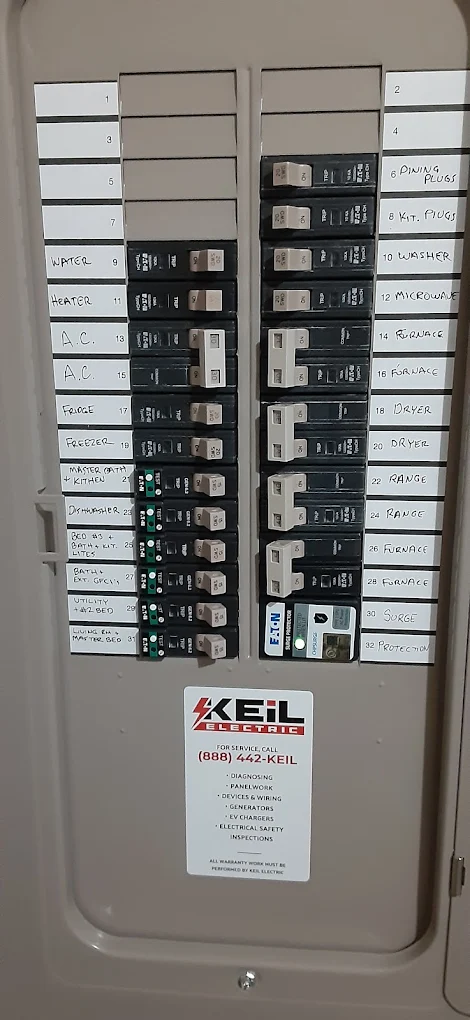
- Eaton (formerly Cutler-Hammer). The other major US-market residential panel. CH and BR breaker formats. Full breaker availability across protection types.
- Siemens. Common in residential and light commercial. QP breaker format. Full protection breaker availability.
- GE. Less common in new residential since GE exited that market, but still found in many existing homes. THQL and Q-Line formats. Replacement breakers still available but the brand-direct supply chain has shifted.
- Federal Pacific Electric (FPE). No longer manufactured. Stab-Lok format has documented breaker non-trip failures. Replacement is the trade recommendation when this panel is identified.
- Zinsco / Sylvania-Zinsco. No longer manufactured. Documented internal arcing and bus-bar issues. Replacement is the trade recommendation.
- Challenger. No longer a separate brand. Some Challenger lines have documented breaker issues; replacement is recommended depending on panel age and condition.
Service entrance work
The service entrance is everything between the utility line and the panel. Panel work often involves service-entrance work, particularly during upgrades:
Overhead service
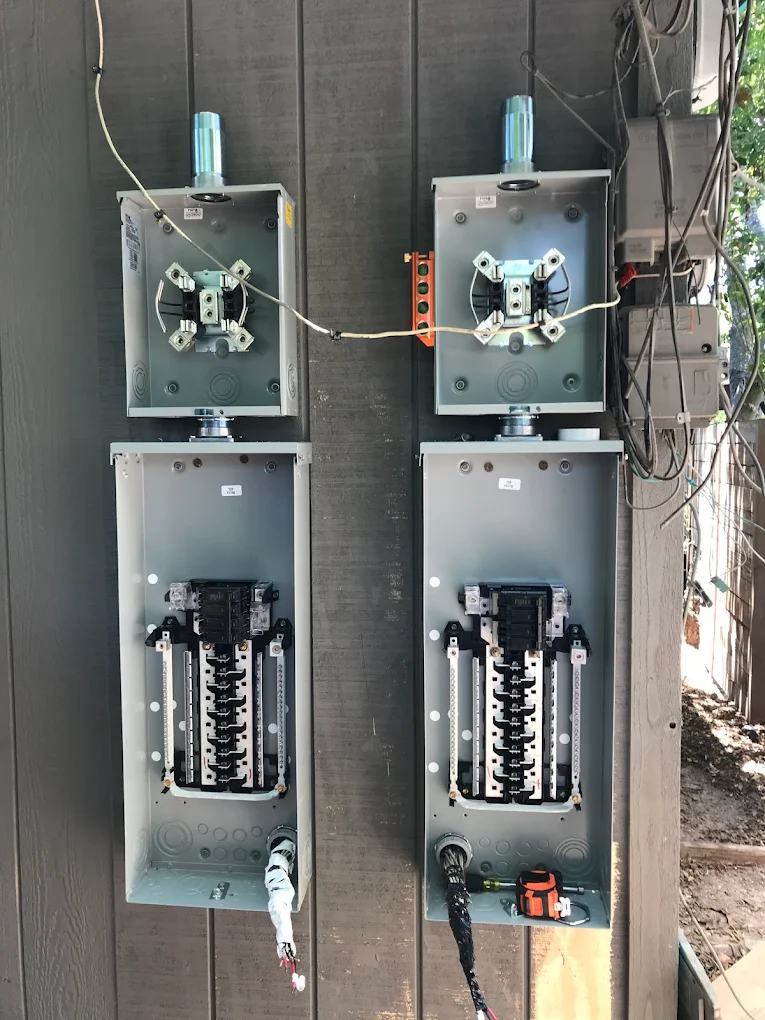
The utility line connects to a weatherhead at the top of a service mast (a metal pipe extending above the roofline), runs down the mast through service-entrance conductors to the meter base, and then to the panel. Common service-entrance issues we find:
- Service mast hardware corroded or pulled loose
- Weatherhead allowing water infiltration into the conductors
- Meter base damaged from physical impact, weather, or age
- Service-entrance conductor undersized for the panel rating
Service mast replacement and meter base replacement are both common scopes during panel upgrades. Both require utility coordination, the meter has to be pulled to disconnect the home from the grid during the work.
Underground service (service lateral)
The utility line runs underground from a transformer (often a pad-mount transformer at street level) to a meter base on the home. The service-lateral conductors are utility-owned in some jurisdictions and homeowner-owned in others. The meter base side is always homeowner.
Issues with underground service tend to be at the meter base or at the transition where the conductors enter the home, uncommon but possible. Damage to the buried lateral itself usually requires utility involvement.
Subpanels: when they make sense
A subpanel is a downstream panel fed from the main panel through a feeder. Common scenarios for adding a subpanel:
- Detached structure. Garage, workshop, ADU, or guest house far from the main panel. A subpanel at the detached structure provides local breakers without long branch-circuit runs from the main panel.
- Heavy-load addition. An addition with significant new load (HVAC, water heater, range, dryer) sometimes gets a dedicated subpanel for the new circuits, with a single feeder from the main panel.
- Main panel out of breaker space. A main panel that has run out of breaker positions but still has service capacity can be expanded by adding a subpanel for new circuits. Cheaper than a panel upgrade if the service rating is sufficient.
- Logical separation. Some homeowners prefer a separate subpanel for shop circuits, exterior loads, or other organized groups.
Subpanels require their own grounding and bonding per NEC 250. The neutral and ground are bonded only at the main panel, not at the subpanel, a common installer error. Feeder sizing follows NEC 215 with the demand factors that apply to the loads served.
Bus bar issues to watch for
The bus bar is the metal strip inside the panel that distributes power to the breakers. Bus bar issues are serious because they affect every circuit in the panel:
- Heat damage. Discoloration, melting, or pitting on the bus indicates heat events. Often caused by loose breaker connections at the stab.
- Corrosion. Greenish or whitish deposits on the bus, typically from moisture infiltration over time.
- Aluminum vs copper bus. Many modern panels have aluminum bus, which is fine when correctly designed but can have issues with dissimilar-metal connections at certain breaker types.
- Loose breaker stab. A breaker that wobbles or does not seat firmly on the bus has a loose connection, which produces heat under load.
Bus bar damage usually warrants Panel Upgrade. Repair is sometimes possible by replacing the affected breaker and verifying the bus contact, but if the bus shows heat damage the safer path is replacement of the panel.
Breaker types and when each applies
Several breaker types cover modern residential and light commercial protection:
- Standard breakers. Overcurrent protection only. Used on circuits without code-required GFCI or AFCI.
- GFCI breakers. Ground-fault protection at the panel. Used on circuits supplying outlets or fixtures in code-required GFCI locations per NEC 210.8.
- AFCI breakers. Arc-fault protection at the panel. Used on circuits supplying outlets in code-required AFCI locations per NEC 210.12.
- Dual-function (AFCI/GFCI) breakers. Both protections in one breaker. Used on circuits where both NEC 210.8 and NEC 210.12 apply (kitchen, laundry in some editions).
- HACR-rated breakers. Sized and rated for HVAC compressor inrush. Used on dedicated HVAC circuits.
- 200A main breakers. Main service breaker protecting the entire panel. Sized to the service rating from the utility.
Compatibility matters: AFCI and GFCI breakers must match the panel’s breaker format. Some older panels do not have AFCI breakers manufactured for the panel’s format, which constrains AFCI installation paths during remodels.