Electrical troubleshooting is the work that happens when a problem doesn’t announce itself. Lights that flicker under load. Power that comes and goes. Breakers that trip with no obvious overload. Equipment that runs hot for no apparent reason. Devices that work intermittently. Half the property without power while the rest is fine. Each of these is a diagnostic problem before it’s a repair problem.
The diagnostic process starts with the symptom and traces the path back to the cause. Symptoms are observable. Causes are what produced them. Common causes for electrical symptoms include loose terminations, damaged conductors, failed devices, undersized circuits, shared neutral failures, voltage imbalance, panel issues, and utility-side problems.
Most diagnostic visits run 60 to 90 minutes. Complex issues that span multiple circuits or involve panel testing can run longer. We always disclose the diagnostic fee up front and apply it toward the repair when the homeowner books the work with us.
What does the diagnostic visit actually cover?
The technician arrives with the symptom in mind and a diagnostic plan. The plan typically follows: confirm the symptom (reproduce the problem if possible), trace the affected circuit from device back to panel, measure voltage and amperage at key points, check breaker condition and load, inspect panel for signs of heat or damage, and identify the cause.
Tools include a multimeter for voltage and continuity, a clamp meter for live amperage measurement under load, a tone generator and probe for tracing cables through walls, an outlet tester for checking polarity and ground, an infrared thermometer or thermal imaging camera for spotting heat at terminations, and a circuit analyzer for advanced diagnostics like ground impedance testing.
The output is a written summary: what we found, what caused it, what the fix is, and any related conditions worth addressing.
Common diagnostic scenarios
Lights flicker when the AC kicks on. The cause is usually voltage drop on the service entrance conductor (utility-side), a loose connection at the main lug, or a shared neutral that’s overloading. We measure the voltage during the AC startup and trace the cause.
Half the property loses power. The cause is usually a failed neutral somewhere upstream of the panel. The two hot legs of a residential service share a neutral. When the neutral fails, voltage between the two legs goes wonky and half the house sees high voltage while the other sees low voltage. This is dangerous to electronics and we treat it as urgent.
A breaker trips at random under low load. The cause is usually a damaged breaker, a fault on the circuit (intermittent short), or an AFCI dealing with a non-arcing condition that triggers its detection logic. We isolate the cause by load testing the circuit and inspecting the wiring at the device and the panel.
An outlet works sometimes. The cause is usually a loose connection at the back of the outlet (back-stab terminals are common offenders) or a damaged conductor where the wire enters the box. Vibration or temperature changes intermittently make the connection. We re-terminate properly with screw terminals and confirm by load testing.
Equipment runs hot. The cause is usually undersized wiring, a loose connection in the path, or equipment that’s drawing more than its nameplate rating because of a fault. We measure conductor temperature with infrared, measure load amperage, and inspect terminations.
Symptoms we can usually diagnose over the phone
A specific dead outlet on a known circuit usually points to: a tripped GFCI somewhere upstream on the same circuit, a tripped breaker, a failed device, or a loose connection. We can walk the homeowner through resetting GFCIs and breakers, and if those don’t resolve the issue, we schedule a diagnostic visit.
A breaker that just tripped during a known event (storm, equipment startup) usually resets cleanly and the issue is the equipment, not the breaker. If it doesn’t reset, the diagnostic visit comes next.
“All the outlets in my bathroom died” usually means a tripped GFCI. Most bathroom GFCI protection is on the bathroom’s GFCI outlet, with downstream outlets protected by it. Resetting the GFCI usually resolves the issue.
Symptoms that need on-site testing
Anything intermittent. Anything that involves heat, smoke, or sparks. Anything that affects multiple circuits. Anything where the homeowner has already done the obvious resets without success. Panel issues. Service entrance issues. Anything where the utility is involved.
Diagnostic fee and follow-up scheduling
The diagnostic visit is a flat fee that gets disclosed when we schedule. The fee covers the technician’s time, the diagnostic tools, and the written report. When the homeowner books the repair work with us, the diagnostic fee credits toward the repair invoice.
Some diagnostics reveal that the existing system is fine and no repair is needed. The diagnostic fee still applies for the visit, but the homeowner walks away with a clean report and no further work.
Some diagnostics reveal larger issues than the original symptom suggested. We document the broader finding and quote the broader scope before doing the broader work.
The diagnostic process: how we find faults
Most electrical faults follow predictable patterns. The diagnostic process narrows the location and cause systematically rather than guessing. The general approach:
Step 1: Document the symptom precisely
“The light does not work” is the start of the conversation, not the end. The full symptom includes: when it started, what changed when it started (a remodel, a storm, an appliance install, nothing), whether it is intermittent or constant, what other circuits or devices are affected, and what the homeowner has already tried.
Step 2: Map the affected area
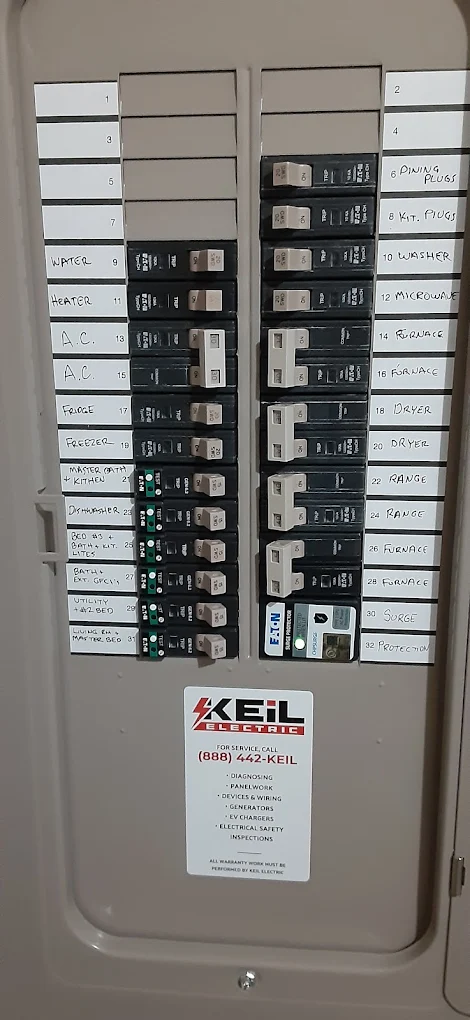
Identify the circuit feeding the affected device. Find the breaker. Confirm the breaker position. Test the breaker itself with a meter (a tripped breaker reads zero volts on the load side; a broken breaker can read voltage but not deliver current).
Step 3: Trace the circuit
From the breaker, trace the circuit through the panel, through any junction boxes, to the affected device. Confirm voltage at each point. The first point where voltage is missing is the fault location, or upstream of it.
Step 4: Identify the failure mode
Common failure modes have characteristic signatures:
- Open circuit (no connection): No voltage past the failure point. Loose terminations, broken conductors, failed switches.
- Short circuit: Breaker trips immediately. Hot conductor touching neutral or ground.
- Ground fault: GFCI trips. Hot conductor touching ground (often through water, damaged insulation, or a faulty appliance).
- Loose connection: Voltage present but reduced under load. Lights dim or flicker, devices overheat, breaker trips intermittently.
- Failed device: No fault in wiring, but the device itself does not function. Outlet contacts have lost spring tension, switch contacts have failed, fixture ballast is dead.
Tools we actually use
Diagnostic work uses a small set of specialized tools:
- Multimeter. Voltage, current, resistance, continuity. The basic instrument for any electrical work.
- Non-contact voltage tester. Detects voltage on a wire without making contact. First-pass safety check before opening any device.
- Receptacle tester. Plugs into an outlet, indicates correct wiring, miswiring, or grounding issues. Fast diagnostic at the device.
- Loaded voltage tester. A multimeter does not catch some faults that a loaded tester does. Loaded testers draw current through the test connection, exposing high-resistance failures that a multimeter misses.
- Thermal imager. Identifies hot spots in real-time. Critical for finding hidden hot terminations before they fail visibly. NEC 110.26 working clearance applies to safe access for thermal imaging at the panel.
- Tone generator and probe. Identifies which conductor at the panel matches which conductor at a remote device. Useful for tracing circuits in homes without accurate panel labels per NEC 408.
- Megger (insulation tester). Tests insulation resistance on conductors. Used when diagnosing intermittent faults that suggest insulation breakdown.
Junction box hunting (the buried-fault problem)
One of the most challenging diagnostics is a circuit where the fault is at a junction box hidden behind drywall. NEC 314 requires every splice to be in an accessible junction box, but older work and amateur modifications often hide splices in walls.
The diagnostic process:
- Confirm the fault is between two known points (at the panel, voltage present; at the device, voltage absent)
- Map the likely cable path between them
- Use a tone generator to follow the cable through the structure
- Open access at suspected junction locations, typically near framing intersections, above and below floor levels, and at any location where the cable changes direction
- Find the hidden box (or the splice without a box, which is itself a code violation requiring repair)
The fix often includes adding a proper junction box per NEC 314 and patching the wall opening. The diagnostic process is the slowest part, once the fault location is found, the repair is straightforward.
Documenting findings
Every diagnostic visit ends with a written report:
- The symptom as described
- The diagnostic process followed
- The fault identified (location, type, likely cause)
- The recommended repair, with scope and rough price range
- Any incidental issues noticed during diagnosis (other faults, code violations, devices nearing end-of-life)
The homeowner gets a copy. The repair, if approved, is quoted as a separate scope. Diagnostic work is billed by time at a documented rate; the repair price is fixed-scope. The homeowner sees the diagnostic cost before we start and the repair cost before we proceed.
When the fault is bigger than expected
Sometimes the diagnostic uncovers something larger than the original symptom. A single dead outlet turns out to be on a circuit with multiple loose terminations. A burning smell turns out to be at the panel’s main lug. A flickering light leads to a service-entrance neutral problem that warrants utility involvement.
When that happens, we stop, document what we found, and discuss the broader scope before proceeding. The homeowner makes the call on how far to extend the work. We do not silently expand the scope to grow the bill, the conversation happens before any additional work begins.